
Elementor Pro (abbreviated as Ele) has become an ecosystem for WordPress website development, boasting a vast user base and a wide range of compatible plugins; it is highly flexible, free, and powerful. Historically, however, freedom combined with power has often led to problems. Slow performance and frequent bugs are the Sword of Damocles hanging over Elementor’s head.
Most of the Elementor users on the network are novices, do not understand the technology and even do not know how to build a website, I heard that WP is easy to operate on the try to make their own. Make a bunch of problems said Elementor slow, many problems. In fact, Elementor can do very fast and stable, just need to set up and avoid some pit operation on the line.
Write this "Ultimate Elementor Speed Optimization Tips" is to help newbies to use Elementor stably and quickly, and to make a contribution to the development of Chinese WordPress website building.
Why is Elementor stuck?
Elementor is very powerful with many widgets to achieve various functions and layout, and a variety of settings are very user-friendly. Behind each feature is a stack of code, so Ele adds a lot of code to the front end, and the code depends on each other, making it impossible to disable and delay loading, so it's slow.
In fact, Elementor pages can be incredibly fast! If you use the Astra theme and import any Elementor full-site template from the accompanying Premium Starter Templates plugin, you’ll find that the site loads very quickly and scores high on Google’s speed test—even without compressing images, installing a caching plugin, or optimizing the code.
Said Ele slow most people do not know how to set up and optimize, Ele speed has a very large optimization space, plug-in team is also very concerned about the speed has been to reduce the amount of code to improve loading efficiency. Diiamo Website Building all the sites unified use Ele, after optimization Google speed score can do 100 points, computer loading time within 1 second, cell phone within 2 seconds.
Why Does Diiamo Stick with Elementor?
People who understand Elementor’s advantages and can use it to build lightning-fast websites are determined to stick with it. Those who don’t understand Elementor—whether because they can’t take full advantage of its speed or simply don’t use it at all—will choose to disparage it.
When people say Elementor is slow, it’s because they don’t know how to use it properly and aren’t able to maximize its speed—it doesn’t mean Elementor is actually slow. Other people’s personal opinions reflect only their own perspectives and abilities; they do not represent the actual facts.
The main advantages of Elementor are its efficiency, visual appeal, powerful features, and ease of use. It offers a wide variety of widgets and third-party templates that enable a wide range of functions and layouts, allowing you to create stylish and visually appealing websites. You can also export, copy, and paste content and templates to other websites, making it extremely convenient and efficient. These are advantages that fast page builders like Gutenberg and Bricks simply cannot match.
Plus, Ele is easy to use and has a low learning curve—our website-building clients can learn to adjust the layout and replace content on their own in just a few minutes. It’s super convenient! Choosing Ele is a great decision for our clients.
做网站的最终目的是为了赚钱,高效、美观、功能强大、易操作才是产生效益的因素。至于速度有100种方法去提升(例如升级服务器配置,用好点的CDN、使用轻量主题、插件等),没必要为了芝麻丢了西瓜放弃它。
Besides, Elementor actually places a lot of emphasis on speed and has been continuously improving it. For example, it has replaced all icons with SVG icons and only loads the relevant code on pages where certain widgets are used. Other optimizations:
Compared to version 3.1, Elementor 3.2 managed to reduce the size of the JS file by 195kb, from 331kb to 136kb, and the CSS file by 11kb, from 146kb to 135kb.
Compared to version 3.2, Elementor Pro 3.3 managed to reduce the size of the JS file by 95kb, from 199kb to 104kb, and the size of the CSS file by 152kb, from 206kb to 54kb.
Elementor Pro plugin has zero CSS weight: Elementor Pro now starts with zero CSS by default, which means that when you start using the plugin, it doesn't have a CSS weight until you start adding widgets. This approach dramatically reduces the CSS size of your site, making it faster and more efficient.
Previously, all 32 WooCommerce widgets were loaded with CSS even if only one widget was used, but since Elementor 3.25, WooCommerce widgets have been conditionally loaded based on usage, saving as much as 197KB of CSS. This eliminates unnecessary loads and makes WooCommerce sites This eliminates unnecessary load and makes WooCommerce sites significantly faster.
Similarly, global styles are now conditionally loaded, which further reduces the CSS file size by 65KB.
Elementor Widget Styles: Starting 3.25, widget styles are conditionally loaded. Instead of loading the entire style set at once, this update now loads the styles for each of the 6 theme element widgets, 3 rotating widgets, and 2 form widgets.
Updated April 27, 2026:Elementor V4+ The new version has a smaller DOM footprint and offers improved speed and performance. Additionally, Elementor has officially launched an AI website builder feature that allows you to edit and modify websites using widgets, rather than working with raw code.
Diiamo consistently uses Elementor and WooCommerce to build e-commerce websites for international trade, employing in-depth optimization techniques to achieve a speed score of around 100 (according to Google Speed Test). In the future, there may only be two types of page builders: one called Elementor, and the other called “everything else.” Elementor is and will remain the top choice for WordPress website development.
Elementor Setup Guide: Get Up and Running as Fast as Possible
There are many features in Elementor’s settings that can reduce code volume and improve loading speed. We recommend enabling the relevant features as described in the tutorial below. Features not mentioned here do not affect speed; enable them as needed.
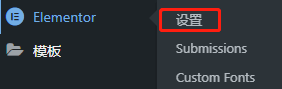
Go to "Elementor" > "Settings" and enter the "General" tab.
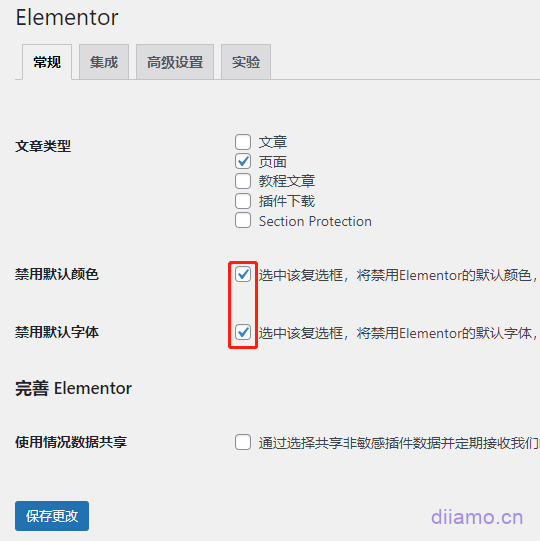
文章类型:选择哪些页面可以使用Elementor编辑制作,按需勾选,一般只勾选页面。
"Disable Default Colors" and "Disable Default Fonts": We recommend enabling these options. This will allow the theme's font and color settings to control Elementor's styling, ensuring a consistent look across the entire website and making future modifications easier.
如果你使用Hello Elementor之类没有单独设置颜色和文字的主题,或者你不想使用主题的设置控制Elementor样式,这里不要启用。
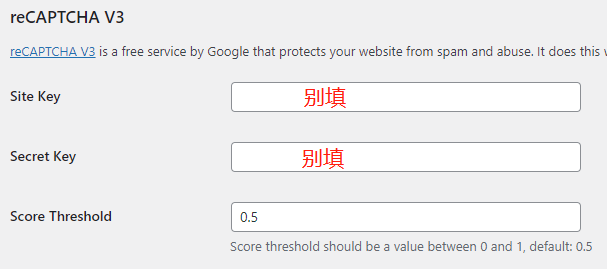
Click to open the “Integration” tab. We recommend keeping all settings at their defaults and not making any changes. If you enter a key for reCAPTCHA or reCAPTCHA V3, Google's verification code will load on every page, which can slow down the site—especially for websites hosted in China.
We do not recommend using Google reCAPTCHA, as it is too slow and does not work in mainland China. Switching to a honeypot combined with a blacklist of keywords provides better results and is faster. For more details, please see “Beat CAPTCHA! The Best Method for Blocking WordPress Spam Comments—Fast and Highly Effective.”
接下来进入“高级设置”选项卡↓。

Switch Editor Load Program Method:Enable and troubleshoot.
启用未过滤的文件上传:Disable to improve security. When uploading this type of file, you will be prompted whether to allow uploading or not, so just choose "Optimize internally" and it will not affect the upload.
Google Fonts:If you plan to use system fonts or upload custom fonts, leave this option turned off; otherwise, you won't be able to select Google Fonts in the Elementor editor.
If you want to use Google Fonts but your theme doesn’t include them, enable this feature. Then enable the “Load Google Fonts Locally” option in the “Performance” tab. Plugins like Perfmatters also offer a “Optimize Google Fonts” feature. You only need to enable it in one plugin; disable it everywhere else.
Form Submissions:If you use a form like Fluent Form and don't use the Elementor form widget, set it off here to save resources.
Load Font Awesome 4 support:Be sure to turn it off for a big speed boost. The loaded Font Awesome icon font is over a hundred kilobytes in size, and it's a priority loading level, which really affects the speed!
生成器标签:建议禁用,原则是一切没多大用处的功能尽量关闭,保持简洁。
Next, go to the “Performance” tab↓, and be sure to read the explanations below carefully before making any settings.

CSS printing method:Be sure to select “External Files”—they can be cached, and you can set the loading priority, which significantly improves speed. You can also disable unnecessary code using the Perfmatters plugin. Maximum speed boost!
优化图像加载:如果已经使用Perfmatters之类插件的图片优化功能,这里选择禁用,否则启用。启用后在首屏LCP图像上会添加 fetchpriority="high" 提示浏览器优先加载相应图片,提高加载速度,改善谷歌测速提示的LCP加载时间过长问题。
Once enabled, it will also add `loading="lazy"` to images that are not on the first screen, instructing the browser to delay the loading of these images that do not need to be displayed immediately. This significantly reduces the amount of content to be loaded and improves loading speed.
Optimize Gutenberg Loading: If you're using the Gutenberg editor, enable this feature; otherwise, disable it. Gutenberg is difficult to use, so Xiao Di disables it on all the websites he builds and uses the Classic Editor instead. We recommend using plugins such as Advanced Editor Tools (ASE) to disable the Gutenberg editor and replace it with the Classic Editor.


延迟加载背景图像:Enable on demand, if your site has other plugins (such as Perfmatters) have the same function, it is recommended to enable this function in other plugins, disable it here, otherwise enable it.
Xiao Mo, I’ve used this feature in Elementor and found it to be just okay—some Elementor widgets outside the above-the-fold area don’t have their background images loaded lazily. On the other hand, Perfmatters’ lazy-loading feature for background images works perfectly.
Tips: “Lazy-load background images” and the Elementor Video widget use their own JavaScript code for lazy loading, rather than WordPress’s native loading functionality.
Load Google Fonts locally:If the “Google Fonts” feature under “Advanced Settings” above is not enabled, we recommend disabling it here. Alternatively, you can use a plugin such as Perfmatters, which offers the same functionality; in that case, enable it in the plugin and disable it here.
元素缓存过期:This option will only appear if you enable the “Element Cache” feature in the “Features” section mentioned below. This setting controls how often the element cache is regenerated. If you make frequent changes, keep the default setting of 1–3 days; if your website rarely changes, you can set it to 1 week, 1 month, or longer.
Markdown Cache:You must enable the “Generate website markdown” feature under “Features” for this setting to appear. We recommend setting it to about “1 week.”
Finally, go to the "Features" tab ↓. "Ongoing experiments" Enable the features as suggested below, it will help to increase the speed! Just try to leave the settings that are not mentioned as default.
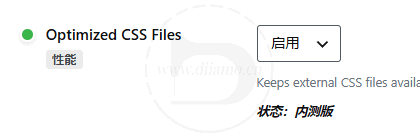
Optimized CSS Files:It is recommended to enable this feature to resolve the issue where the front end continues to display the old styles even after modifying them on the Ele editing page.

Generate website Markdown:Enable this feature to allow AI bots to read, understand, and interact with website content more effectively.
Convert content to Markdown format to simplify the page structure, making it easier for AI agents to understand and interact with your website. When this feature is enabled, it processes your page content, removes redundant HTML and JavaScript, and generates a simplified Markdown version.

Menu:Enable on demand. Enabling it adds a new Menu widget to Elementor, which allows you to make super navigation menus, the kind of large and very complex Mega menus. If the existing Ele's Menu widget can meet your needs, you can not enable it here. Xiaodi thinks it may become a standard feature in the future, and can't be turned off by default.
The following is the "Stable features" setting ↓.

内联字体图标:You can turn the icon font into inline SVG icons, a great improvement in speed! Note: star rating RatingRating widget stars do not choose Fontawsome, otherwise it will aggravate a more than 70KB icon font, choose the beginning of the U that is SVG icons.

More custom breakpoints:Enable on demand. The default website has 3 ends, mobile, tablet and PC, and you can customize to add more ends after enabling. By default the PC end settings do not take care of the display effect of regular size laptops, and many PC end pages are badly displayed on laptops.
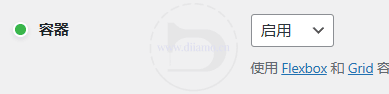
Container:Once enabled, you can use Flexbox and Grid Containers to build page structures, which are more flexible and powerful than the previous section/column layouts. This also reduces the DOM size and improves page speed.
diiamo recommends enabling this feature and adding a mobile version. If your website has a simple design, doesn’t have complex compatibility issues, or if you’d rather not go through the trouble of setting up four versions, you can disable it.

Optimize markup:Enabling this feature can reduce the DOM size and improve performance. If you’ve previously added a lot of custom CSS to control the appearance of Elementor widgets and your CSS class names use Elementor container names, enabling this feature may cause some CSS to stop working. Be sure to check your styles after enabling it.

Default to New Theme Builder:This feature can be enabled on demand. Once enabled, the “Templates” section will feature a stylish UI design, allowing you to preview how the templates will appear. diiamo (https://www.diiamo.cn) feels that this feature isn’t very intuitive or user-friendly, so it has remained disabled.

If you're using the Hello Elementor theme, there will be a “Header & Footer” option, which duplicates the feature in Elementor Pro for creating header and footer templates. If you're only using the free version of Elementor, which doesn't include this feature, enable it.
If you're using Elementor Pro or another Elementor add-on plugin that includes a feature for creating header and footer templates (such as Elementor Skit), you don't need to enable this feature.

Data Sharing:Disable it—no one likes handing over their data to others; it slows things down and poses security risks.
Elementor Speed Optimization Tips
This tutorial focuses solely on optimizing the speed of the Elementor page builder. Please also follow the instructions in the "Ultimate WordPress Speed Optimization Tutorial》Optimize other aspects of the articles to comprehensively improve the website's loading speed.
Using the new version of Elementor V4
Elementor has released a new version, V4, which features cleaner code, a smaller DOM, improved efficiency, and more powerful features. Go to the interface shown below and click the pink button to switch to the V4 version—you’ll notice a significant speed boost.
Note: To achieve faster performance, you must use the new V4 widgets; do not continue using the old ones. The new widgets have a smaller DOM footprint and offer better speed and performance.
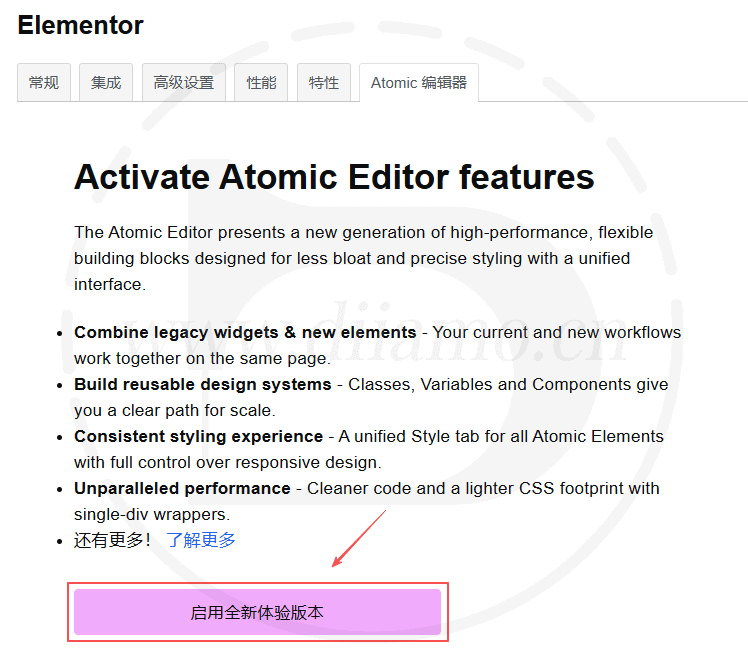
The V4 version is definitely the future of site building, make sure you use it.

Increase the memory used by Elementor
Elementor very eat configuration, if the content is not enough is very easy to card, most hosts by default the available memory is only 64M or 128M, so you need to modify the PHP memory limit as well as the site may be the maximum memory.Ele editing interface widgets have been spinning around not loading, basically not enough memory to cause.
How to make the change: First, go to the PHP settings and adjust the `memory_limit` value: set it to 128M for 1G of RAM, 256M for 2G of RAM, 512M for 4G of RAM, and 768M for 4G or more of RAM. After making the change, it is recommended that you restart PHP; there is no need to restart the web hosting server.
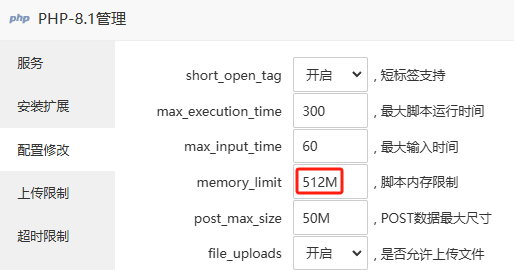
不知道怎么改memory_limit?问服务器客服、建站客服、百度客服。
Go to the FTP file manager, locate the wp-config.php file in the root directory, and open it.  , add the following code to modify the memory limit. Add the code above the line “/* That's all, stop editing! Happy publishing. */”.
Change 1 GB of memory to 128 MB, 2 GB to 256 MB, 4 GB to 512 MB, and memory above 4 GB to 768 MB. If the website has a large number of plugins, set it to at least 512 MB for optimal performance.
define('WP_MEMORY_LIMIT', '256M');

Disable Elementor Google Fonts
Google Fonts are slow, and Xiao Di wrote in *Ultimate WordPress Speed Optimization Tutorial》As mentioned earlier, Google Fonts are slow, so try to avoid using them and switch to system fonts instead. This is especially true for websites in mainland China, where using Google Fonts can cause significant lag. If you absolutely must use them, you must host them locally.
For websites hosted on the mainland, you need to disable the Google Fonts feature in Elementor's “Advanced Settings.”

Follow the Elementor setup tutorial above to use the theme’s default font. When building pages with Elementor, keep the fonts in the widgets at their defaults—do not change them. Then, configure the fonts in the theme settings. If you choose Google Fonts, use the appropriate plugin or the theme’s built-in functionality to host the Google Fonts locally.
Don't use Elementor to build whole site content
This is the key to Elementor speed optimization! And the best way to get the best results!
We have published in theUltimate WordPress Speed Optimization TutorialAs mentioned in 》, the best way to optimize Elementor is to avoid using it to create site-wide elements such as headers, cookie consent pop-ups, and form pop-ups. Instead, use your theme or other plugins to create these elements.
Because Ele’s code is interdependent—a single widget may involve more than a dozen files—these files cannot be lazy-loaded or disabled. This is the root cause of Ele’s performance issues. For example, to properly display a mobile menu created with Elementor, you need to exclude the JavaScript shown in the image below from being lazy-loaded.
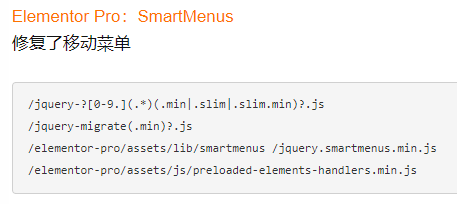
In order for some elements, galleries and entry animations created by Elementor Pro to display properly, it is necessary to exclude the JS from being delayed in loading in the figure below.
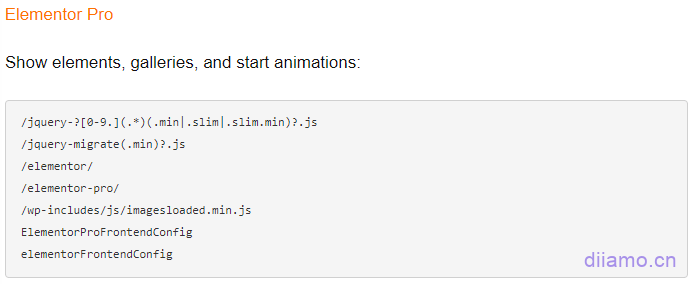
Excluding so much JS is delayed loading, the speed can be improved much less space.
If your blog pages and product pages are built using the theme and do not contain any Elementor code, you can use the Perfmatters plugin to disable all Elementor code on those pages, which will significantly improve loading speed. The Google PageSpeed Score for mobile will reach 95–100.
If the theme you're using doesn't give you the look you want, we recommend switching to the Astra Pro theme—it's fast and looks great.
If possible, I’d also recommend using Astra Pro to build post/product detail pages and list pages—they look great and load quickly. Some features on these pages can be implemented by installing separate plugins; for example, the table of contents on post detail pages can be created using the lightweight Fixed TOC plugin, and the inquiry form on product detail pages can be built using the lightweight Fluent Forms plugin.
You can also write code manually (hard-coded) to create headers, footers, etc., faster!
Many websites create cookie notification bars; we recommend using the Cookie Bar plugin to create them, as it’s lightweight—diiamo uses it as well.

If you want to add content such as text, buttons, forms, images, videos, and tables to a page, you can use the ACF Fields plugin along with the hook code insertion method.
Disable useless Elementor code
Although Elementor's code depends on each other, there is still some useless code that can be disabled. Disabling it will further improve the speed, which is the top priority of Elementor speed optimization.
To disable code, you'll need the Perfmatters plugin. Click here to learn how to use the Perfmatters plugin to disable unnecessary resources. The link contains the "Advanced Paid Optimization Tutorial》lists which Elementor and WooCommerce code can be safely disabled.
Note: ":Advanced Paid Optimization Tutorial》 is premium content that includes advanced optimization strategies, techniques, and in-depth guidance on using plugins. It will help you take your website’s speed optimization to the next level and enhance your WordPress speed optimization skills.
After purchase, enjoy one-on-one consultation via WeChat↓, where a representative will analyze your website's issues and provide optimization suggestions and ideas. If you have any other questions regarding speed, feel free to leave a message or contact customer service.


Delayed loading of JS code, generation of critical CSS, delayed loading of images
For Elementor JS/CSS that cannot be disabled, you should use lazy loading or generate critical CSS to optimize loading efficiency and reduce page load time. For a detailed tutorial, please see “Ultimate WordPress Speed Optimization TutorialThe.
Elementor page building tips
There are many ways to implement the same design when building pages with Elementor. A good build method can effectively reduce the amount of code and is very helpful in optimizing the speed of Elementor.
Minimal use of widgets or Containers
1- If a layout can be achieved with a single widget, don’t cobble it together using multiple widgets. For example, instead of using three separate widgets—an image, a title, and a text description—to create a layout with an image, a title, and text, you can achieve the same result with just one “Image Box” widget, which is faster.
2- Use Container as little as possible, make good use of Flex features. For example, if there are 4 horizontal content blocks inside a section, some people will create a large Container with 4 small internal Container, which is very convenient, but the amount of code will also increase a lot. You can use only one Container, set the alignment direction to the right, and set the width of the four internal elements to 25%, so that you can also be arranged horizontally.
3- Don't use multiple widgets to accomplish something that can be done with just one. For example, the content in the image below contains many elements; some people might use widgets such as an image, a heading, a divider, text, and another heading to create it.
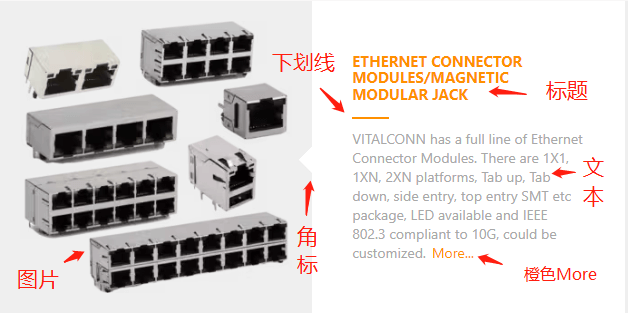
If it is the same as the picture below, there are 4 pieces of content, and each piece of content consists of several widgets, to achieve this layout, you need to put each piece of content into a separate Container, and then set it to 50% width to achieve the layout below. This will use a total of nearly 20 widgets, 5 Container.

The above picture is actually a foreign trade station building a customer's electronic products B2B website section, Xiaodi only use 1 Container + 4 image box widgets to achieve the same layout effect, greatly reducing the amount of code.
Some people are wondering how to create the orange underline, superscript, and the orange “More” button using an image box. The answer is to use the CSS `before` and `after` pseudo-classes. Xiao Mo has pasted the CSS code here for your reference. "#productdisplay" is the ID of the `Container`, and `var(--ast-global-color-0)` is the color code for the Astra Pro theme.
#productdispaly figure.elementor-image-box-img { padding: 20px; background-color: #efefef; max-width: 50%; z-index: 1; } #productdisplay .elementor-image-box-content { padding: 25px 40px; max-width: 50%; z-index: 2; } selector .elementor-image-box-img:after { content: ""; border-radius: 0px; background-color: #ffffff; display: block; width: 18px; height: 18px; -webkit-transform: rotate(45deg) translate(-50%); transform: rotate(45deg) translate(-50%); z-index: 2; position: absolute; right: 50%; margin-right: -15px; top: 50%; } #productdispaly h3.elementor-image-box-title:after { content: ""; background-color: var(--ast-global-color-0); display: block; width: 37px; height: 2px; margin-top: 15px; } #productdispaly p.elementor-image-box-description:after { content: "More..."; color: var(--ast-global-color-0); margin-left: 6px; font-size: 14px; }
4- Try to use the same type of widget whenever possible. For example, if several pieces of content can be displayed using an Image Box, use that for all of them instead of an Icon Box.
5- Use global styles for fonts and colors instead of setting them individually for each widget.
6- Avoid deeply nested containers. Do not place container B inside container A, then place container C inside container B, then place container D inside container C... This will cause the system to freeze.
Try to avoid using heavy asset widgets
Widgets such as slideshows and carousels load very slowly, and they often flicker without styling during the loading process, which negatively impacts the user experience. Websites that load quickly generally do not use these widgets.
You can take a different approach when designing pages. If you want to display a large number of photos, we don’t recommend using a slideshow; instead, arrange them in two rows side by side. The same applies to products—there’s no need for a carousel; simply display them all in two rows.
Don’t use a carousel for the banner at the top of the homepage—it slows down the page and results in low conversion rates. Using a single image as the background and placing text over it yields the best results, with the highest conversion rates and fastest loading times. Less is more; more is clutter.
If you want to display WooCommerce products, try to avoid using the Product widget. Instead, use the Image Box widget, set the image to the product image, enter the product title in the "Title" field, and enter the product link in the "Link" field.
Try not to use third-party Elementor extension plugins
Try not to use third-party Elementor extension (Addon) plug-ins, Ele is already bloated code, and then install extensions plug-ins on the card on the card. Especially Element Pack and Elementor Skit plug-ins, front-end loading too many resources, the volume is large! Customers pay to find Xiaodi optimization speed, see the installation of these Addon plug-ins head is big.
In addition to having a large number of resources, these add-ons are also difficult to optimize. For example, when using Ultimate Addons for Elementor to create a header slideshow, in order to improve speed and ensure the content displays correctly as quickly as possible, you need to disable the delayed loading of all the JavaScript shown in the image below, which significantly slows down the loading time.
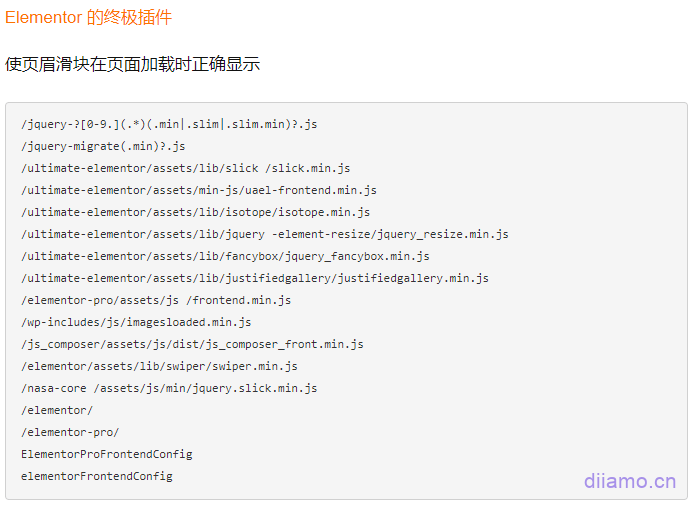
If there are features that Elementor doesn't support, you can try having someone write custom JavaScript or CSS to implement them. If you absolutely must use a third-party Elementor extension to implement these features, try to choose a lightweight extension like Jet Tabs, and use it only to build content outside the above-the-fold area.
Di in the background of the site to see people searching for SeedProd plugin, which is used to do only the landing page, in fact, the use of Elementor can make a variety of landing pages, there is no need to install a separate plugin.
Creating Sidebars, Live Chat Panels, and Floating Bars with Elementor
Many websites create a floating customer service sidebar to boost conversion rates and provide a "Back to Top" function. This is typically done using plugins like Chaty Pro, but these plugins inject over 100 KB of code into the front end, which slows down the site.
We recommend using Elementor Pro to create sidebars, live chat panels, and floating bars. It doesn’t add a single line of code, is the fastest option, and offers a high degree of customization—it’s absolutely perfect.
diiamo has created several templates for floating sidebar live chat panels using Elementor Pro ↓. If you're interested, feel free to download and use them.

Use "Transform" instead of "Margin"
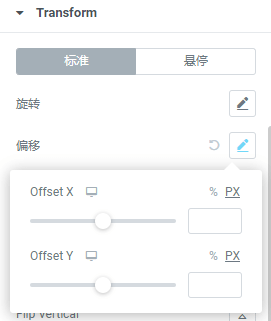
7- If the section moves horizontally/vertically to a large extent, even outside the screen, try to use "offset" in "Transform", not "layout "Layout" inside the "distance (margin)". This can avoid the "Layout Offset" error prompted by Google's speed measurement tool.
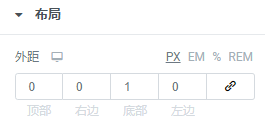
Use Icons+Popup instead of mobile navigation
It is mentioned above that you should not use Elementor to make the header, but use the theme to make it much faster. However, the theme header builder has many limitations and may not meet the needs of some people, so they will still choose Elementor to make the header.
The Elementor menu (Nav) widget loads slowly on the mobile side, so it is recommended to hide the menu on the mobile side. Use Icon widget to make mobile menu icons, use Popup to make mobile menu navigation and link to Icon icons (remember to hide them on the computer side), it is much faster.
Try not to use entry animations
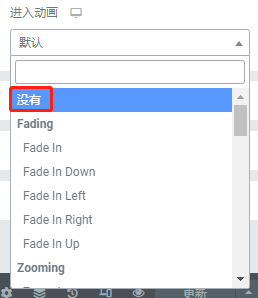
You can set up entrance animations (under "Animations") for sections built with Elementor, which look pretty cool and enhance the website's sophistication. However, this increases CPU usage, JavaScript load, and rendering time. Try to avoid using entrance animations whenever possible. If you must use them, we recommend applying them only to sections outside the above-the-fold area; do not apply any animations to content above the fold—it’s best to disable them entirely.
In order to comply with EU regulations, many websites will have created a cookies collection alert bar (below).
Small D tested, this tip bar set up out of the animation Google PageSpeed test tool mobile loading time of about 2.0 seconds, cancel the out of the animation/conditions or delete Cookies collection tip bar loading time of about 1.7 seconds. If you change the page down (below) to a certain distance and then show the page, the loading time is about 1.4 seconds. It is recommended to set On Scroll 10% or so to display the Cookies Collection Tip Bar, the speed is greatly accelerated, and the score is also much higher.

Elementor Frequently Asked Questions & Solutions
The key to solving a problem is first understanding what the problem is and pinpointing its source. If you’re trying to edit a page using Elementor and the editor won’t open, first check to see if you can use Elementor to edit other pages.
If none of the pages load, it’s likely a problem with a plugin or the website itself. Disable all plugins except for the two Elementor plugins, and switch to a default theme like "2025" to see if that resolves the issue. If it does, the problem is caused by a plugin conflict or a theme issue. Enable plugins one by one and switch back to a commonly used theme until the problem reoccurs, then pinpoint which plugin or theme is causing the issue and address it accordingly.
If only a few pages can not be opened, that is the page inside something wrong, the probability is that manually add the code out of the problem, such as adding the code to write a , forget to write , combined with the error logs to check their own.
Elementor regular page cannot be edited, Post content is missing.
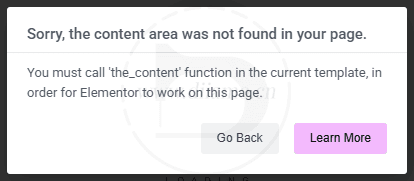
Xiaodi once mistakenly set the effective range of the post detail page template (or may be other templates, go to Elementor > Templates > Theme Builder to check) to "All Singular". This scope will override the regular page, so editing the regular page is equivalent to editing the post detail page template, but there is no post widget on the regular page, so it prompts an error.
Just change the scope of the template, e.g. article > all, or if it doesn't work, disable and restart the Elementor free and Pro plugins.

If you have not created a Woocommerce product detail page or article detail page template in "Elmentor" > "Templates", and you are editing the product detail page or article detail page directly in Elementor, you will also get this error This error occurs when you use Elementor directly to edit the product detail page or article detail page. You need to create a template in "Elmentor" > "Templates" first.
The template can be used to put only the product/article detail widgets, set the hidden widgets, and set the template to take effect for all products/articles. Then just use Elementor to edit the product detail page/article detail page.
It could also be due to a plugin conflict or an incorrect URL. For more details, see this official Elementor article.
Update 2025.06.05: A new site with only Elementor installed, using the Gutenberg and 2025 themes, had this problem when creating footer templates. Changed to Classic Editor and switched to Hello theme back to normal.
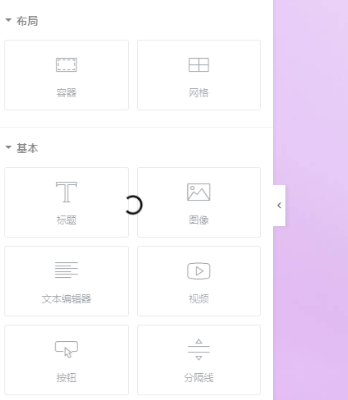
Elementor editing interface left widget loads out and keeps spinning in circles
Many users have reported this issue: when editing with Elementor, the left panel keeps spinning, the page fails to load, and editing is impossible, as shown in the image below. This is typically caused by poor internet connection, insufficient memory, or plugin conflicts. Follow the steps below to troubleshoot the issue one by one:
1- First, check the section above on increasing Elementor’s memory allocation and try increasing the memory for your website. If your website uses a large number of plugins, we recommend increasing it to at least 512 MB for better performance;
2- Server lag, enter the pagoda and so on to see the load. If the server process is stuck, it's usually because the information is not good or the optimization is not good, so I suggest you to change the server;
3- URL conflict, if there are 2 pages with the same URL set, it will not open;
4- If you open the ladder, change the line to see, slow network can also lead to slow loading. If it still does not work, great probability is caused by plug-in conflicts, one by one to disable the plug-ins that may conflict, until the problem is solved;
5- It could also be a bug in a specific version of Elementor; for example, version 3.26.0 had this issue. When Elementor releases a major update, don’t rush to update—wait about a week to see if a new version is released before updating;
6- Plugin conflicts—this is the most likely cause. For example, an earlier version of Rank Math conflicted with Elementor; upgrading to the Rank Math Free or Pro versions resolved the issue. Try disabling all plugins except Elementor to see if the issue is resolved. If it is, enable plugins in batches of 2–3 at a time, refreshing the Elementor editor each time, until the problem reoccurs, to identify which plugin is causing the issue;
7- Browser extensions conflict, for example, Chrome some browser extensions will cause some functions of the site abnormal. Use the browser privacy / no trace mode to open to see if it is restored.
8- There is an issue with the syntax of the Content-Security-Policy security header on the website,Elementor Editor Requirements unsafe-eval. To fix this, remove the Content-Security-Policy header, or set its value to "frame-ancestors 'self'" always;
Elementor editing interface can not be saved, click "update" does not respond
General refresh can be solved, or not if you press the above problem ↑ solution.
Elementor update page is displayed incorrectly or does not show the update
Sometimes this issue occurs when updating a plugin. Try editing any page in Ele, make a few changes, click “Publish/Update” to save, and then refresh the front end—the page should usually return to normal. If it doesn’t, try the methods listed in the table below from the official guide, one by one.
| Causes of problems | prescription |
| Document or data file issues | 1. Go to WP Admin > Elementor > Tools. 2. Click Regenerate Files and Data. |
| Caching and optimization issues | 1. Clear optimizations and cache third-party plugins before updating, and make sure they are disabled when updating. 2. Ensure that server caching is not enabled, and you may need to consult with your current hosting provider for more assistance. |
| Elementor Functionality Issues | 1. Disable Elementor features to resolve issues with experimental features, primarily performance-related features such as inline font icons and improved CSS loading. 2. Go to WP Admin > Elementor > Settings > and disable the corresponding features. |
| Third-party plug-in conflicts | Disable all plugins other than Elementor and Elementor Pro on your boarding site to eliminate any possible conflicts with third-party plugins. |
| WordPress Theme Conflicts | Switch your theme to any default WordPress theme or Elementor Hello theme. |
| Classname name change | Sometimes, Elementor updates remove or modify the class names of certain divs to optimize speed and performance. If you previously added custom CSS manually using class names such as “elementor-widget-container,” your custom CSS will stop working after the update, and you’ll need to replace those class names in your code. |
| Json is disabled | Check to see if the individual firewalls are blocking the Json path/function |
| Problems with CSS printing methods | 1. Disable and clear optimization and caching before updating. Ensure that they are disabled when updating. 2. Ensure that you have not enabled server caching. You may need to consult your current hosting provider for further assistance. |
If you use plugins like Perfmatters to remove unnecessary CSS, some new code introduced in the latest version might also be deleted, causing styling issues. Disable plugins like Perfmatters to see if the issue is resolved, then identify the problem and address it accordingly.
Elementor articles don't show the cover image
Elementor posts widget, front-end posts don't show the cover image. This is a problem that Dee has encountered herself, on many sites and with many Ele versions.
As per below, select "Original" for image resolution, just leave Image Ratio blank. Clear all cache, front-end refresh back to normal.

Or you can add a line of CSS code to let the picture show up. We help customers to do the site sometimes customers uploaded pictures of different sizes, need to use this function to crop the picture, Xiaodi will add code to fix this problem.
Elementor builds pages that don't display content, only headers and footers
If you remove the kit inside the template, it may cause the page to display only the header and footer without the site content when you are not logged in.

In "Tools", click on "Rebuild Kit" to create a new kit and save it.
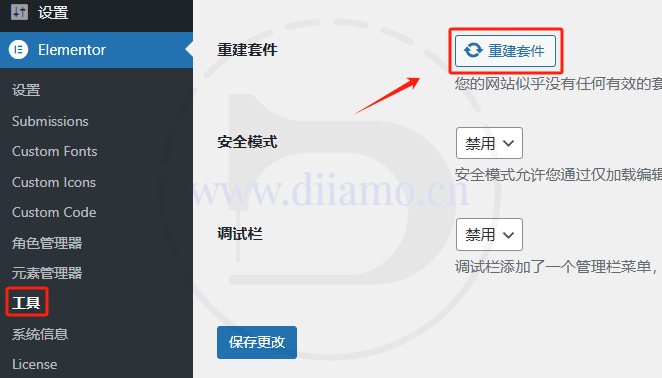
Elementor displays error content and functions abnormally
Elementor’s “Element Cache” feature has a bug. For example, as shown in the summary on the diiamo plugin details page ↓, if “Element Cache” is enabled for a widget, it will display a fixed summary for a specific plugin instead of dynamically fetching the corresponding plugin summary.

“The ”Element Cache“ feature is also incompatible with some plugins. For example, as Xiao Mo mentioned in ”The Best Methods for Blocking Spam Comments in WordPress,” The Cloudflare Turnstile CAPTCHA feature of the Simple Cloudflare Turnstile WordPress plugin may be incompatible with the “Element Cache” feature of the Elementor Form widget; it must be disabled for the two to work together.
If your website encounters similar display content errors or abnormal functions, you can try to disable the "Element Cache" function of the corresponding widgets to troubleshoot. In the widget "Advanced Settings" > "Cache Settings", select "Not Enabled" and save it.

A page Elementor editor won't open, stuck in a dead loop
It's most likely a problem with manually added code—for example, you might have written `` in the code but forgot to include ``. Check the error logs to troubleshoot the issue yourself. To fix it, simply modify the corresponding entries in the database. Be sure to back up the database first, make the necessary changes, and then clear all caches.












5 thoughts on “终极Elementor速度优化技巧, 秒开页面, 附常见问题解决方法”
Sorry, I just swallowed the words in my input method, so I'll re-post it again: blogger hard at work, the article says: Don't use Elementor to build the whole site content. Does it mean that in astra pro you can use the block editing in site builder to do header, footer, page, etc.? Is that what it means? Thank you for your help.
Use Astra's own functions (not Site builder, set/create in Appearance>Customize) to create Header, Footer, product/article listings and detail pages, and use Elementor for everything else.perfmattersDisable useless code for the fastest speed.
Thanks for the guidance.
What plugin are you using for your cookies? Plugins for items can't be set
The alert bar in the article with the green-yellow background was created using elementor popups, which is more recommended to be created using the cookie bar plugin.